Business continuity is simple: keep the business running, no excuses. In the coming year, that promise lives or dies on your ability to absorb a cyber incident without stalling revenue, losing customers, or grinding operations to a halt. Identifying and protecting your critical assets is essential to ensure business continuity in the face of evolving threats.
Ransomware, breaches, and DDoS attacks aren’t “IT problems.” They’re business problems with real costs, including the risk of significant data loss. To withstand operational disruptions, organizations need a robust business continuity plan integrated with cybersecurity measures.
In this post, we’ll break down how cyber threats actually disrupt continuity, where leaders get caught off guard, and the practical moves that build organizational resilience so you can take a punch and keep moving.
Business Continuity in the Digital Era: What It Really Means
Business Continuity Planning (BCP) is essential for maintaining operations and keeping essential functions running during a disruption. Disaster Recovery (DR) restores systems and data after the fact.
You need both, and they must be coordinated.
A comprehensive business continuity plan should identify and prioritize critical business functions to ensure that essential operations are maintained and protected during cybersecurity incidents.
- BCP: Maintain customer service, order processing, and production scheduling even if systems are degraded. Integrating cybersecurity into the business continuity plan helps ensure operational resilience in the face of cyber threats.
- DR: Restore ERP, CRM, databases, and apps to full health with tested backups and failover.
A robust business continuity strategy should include risk management, business impact analysis, and a communication plan as key elements to ensure organizational resilience and clear stakeholder communication during disruptions.
Cyber incidents stress-test both, often simultaneously.
The Cyber Threats Most Likely to Break Continuity
Ransomware
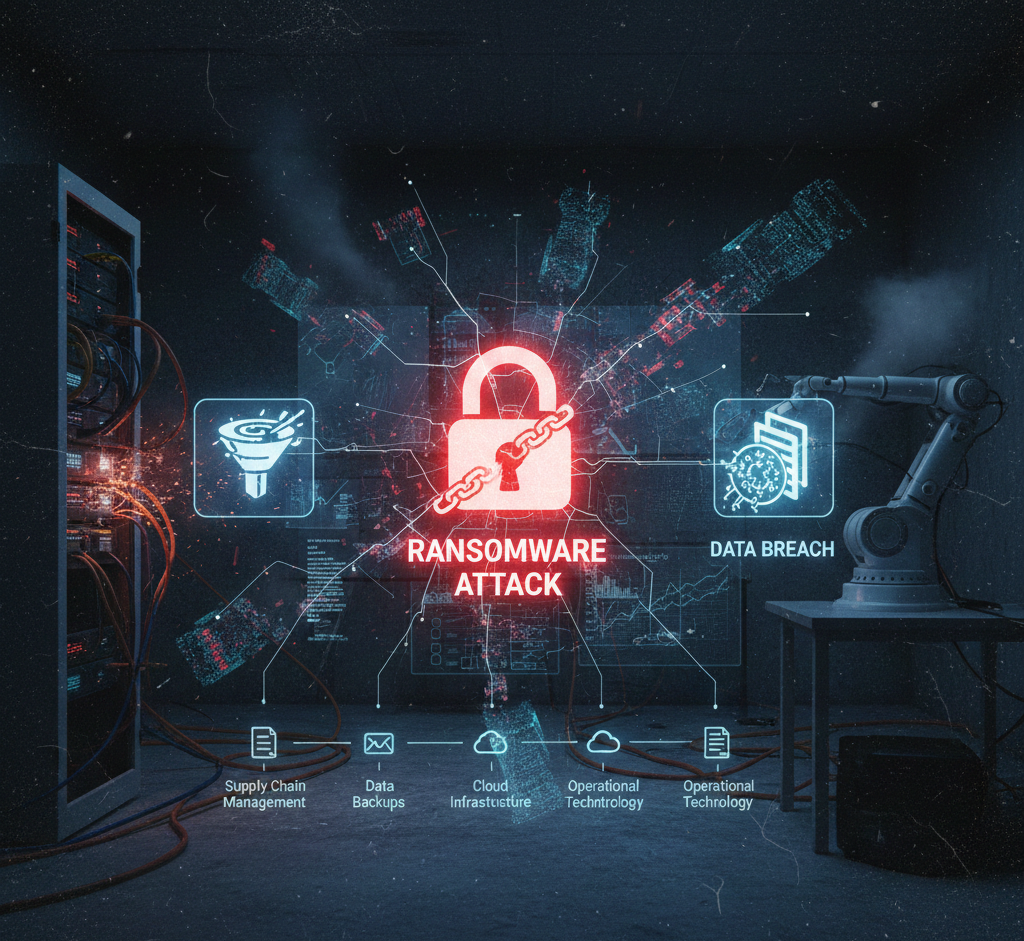
Data gets encrypted, systems lock up, and operations — production lines, order management, invoicing— freeze. Even with backups, recovery takes time. It is vital to have reliable data backup and backup solutions, such as cloud-based or offsite backups, to minimize downtime and support business continuity.
The blast radius hits revenue and reputation. Implementing robust data backup and recovery strategies, including regular secure backups, testing restore processes, and adopting immutable backups, is critical to ensure business continuity after ransomware attacks.
Data Breaches
Unauthorized access to sensitive data, including customer data, can compromise it and trigger legal obligations, investigations, and (often) partial shutdowns to contain the issue. You’re coordinating forensics while managing customer communications and compliance deadlines.
You must also meet regulatory compliance requirements to avoid penalties and maintain stakeholder trust during and after a cyber incident. Protecting intellectual property is equally critical, as data breaches can expose proprietary information and trade secrets, threatening business resilience and competitive advantage.
Phishing & Social Engineering
Stolen credentials provide a fast track to lateral movement, privilege escalation, and (eventually) ransomware or exfiltration. Recognizing phishing emails is crucial, as these are often the initial method attackers use to steal credentials. The first symptom might be unusual access. The second is downtime.
Human error is a significant factor in successful attacks, making it essential to address it through proactive measures. Implementing regular cybersecurity training helps employees recognize phishing attempts, reduces human error, and strengthens your organization’s defenses against cybersecurity threats and business continuity risks.
DDoS Attacks
A distributed denial-of-service (DDoS) attack can flood your websites, APIs, or portals. Customer-facing services slow to a crawl or go dark. If you rely on digital experiences for sales or support, continuity takes a hit.
Intrusion detection systems play a crucial role in identifying and mitigating these attacks before they impact your operations. Protecting sensitive systems from DDoS attacks is essential to ensure business continuity and safeguard critical infrastructure.
Third-Party & Supply Chain Risk
Your ops depend on vendors and SaaS. If a payment processor, identity provider, or logistics partner gets compromised, the disruption lands in your lap, potentially impacting affected systems and the broader IT infrastructure that supports your business.
System failures can result from these incidents, making it critical to implement robust access controls to mitigate third-party risks and protect your organization from unauthorized access and further operational disruption.
The Direct Impact on Operations (and the P&L)
- Downtime = Cost. Disruptions to business operations, especially essential operations, can be devastating. For mid-market teams, a day or two of lost sales, delayed billing, idle labor, rush fees, and SLA penalties can wipe out monthly gains.
- Trust is fragile. Outages and breaches drive churn, slow new logo acquisition, and spike support volume. Maintaining customer confidence and quickly restoring normal operations are critical to business continuity.
- Compliance pressure. Regulations don’t pause for incidents. Mishandled notifications or inadequate controls compound the damage. An organization’s ability to operate efficiently during disruptions is essential to meet compliance requirements and ensure resilience.
- Value chain disruptions. When an ERP is locked, for example, you can’t issue POs. When WMS is down, you can’t ship. When CRM is offline, sales and service stall. Power outages and other operational disruptions can further impact business continuity and the ability to maintain critical processes.
Can a data breach shut down operations?
Absolutely. Containment often requires restricting access, segmenting networks, rotating credentials, and performing forensics, all of which can impact critical business functions. That means controlled slowdowns or temporary shutdowns until the risk is mitigated.
Implementing and regularly testing recovery procedures is essential to restoring normal operations and ensuring business continuity after a cyber incident.
How to Maintain Continuity When Cyber Threats Hit
Think cyber resilience: anticipate, withstand, recover, and adapt by developing robust continuity plans with well-defined key components.
It is essential to regularly test and update these plans to ensure they remain effective against evolving cybersecurity threats and business continuity challenges.
Each critical component of your continuity plan plays a vital role in maintaining organizational resilience and ensuring an effective response to disruptions.
1) Bake Security into BCP
Map your critical processes (order-to-cash, procure-to-pay, production scheduling) to the systems and data they rely on, with a focus on identifying and protecting your organization’s critical assets. Set RTO/RPO targets per process. Prioritize restoration: what comes back first, by whom, and in what order.
When developing your business continuity plan, integrating cybersecurity measures is essential to ensure operational resilience during cyber incidents.
A comprehensive cyber incident response plan should be included in your overall strategy, outlining roles, responsibilities, and procedures for detecting, containing, and recovering from cyber threats.
2) Run Real Risk Assessments
Conduct a thorough risk assessment to identify likely attack paths. Evaluate third-party risk across vendors and integrations. Implement risk management strategies to mitigate vulnerabilities identified during the evaluation. Leverage these tactics to test controls like multi-factor authentication (MFA) coverage, privileged access, EDR, and backup integrity. Understanding and identifying potential cyber threats is essential for developing effective business continuity and cybersecurity plans.
3) Tighten Identity & Access
Enforce MFA everywhere, especially for admin and remote access. Use least privilege and regularly review access. Implement robust access controls to prevent unauthorized access to sensitive information. Also monitor for identity anomalies, such as impossible travel or off-hours escalations.
4) Build Backup & Recovery You Trust
Keep immutable, offsite backups of critical systems as part of your data backup and recovery strategy. Test restores against your RTO/RPO. Reliable backup solutions, such as cloud-based and offsite backups, are essential for mitigating risks from ransomware attacks and hardware failure, ensuring business continuity and rapid data recovery.
You can also use hot/warm failover for customer-facing services. Conduct regular security audits to verify the integrity of your backups and identify potential vulnerabilities.
5) Operationalize Incident Response (IRP)
Define roles, such as an incident commander, technical leads, legal/compliance, and comms, as outlined in your cyber incident response plan. This plan should clearly specify responsibilities and escalation paths, and pre-authorize decisions such as containment steps, vendor escalation, and law enforcement.
As part of the response, ensure rapid identification, isolation, and restoration of affected systems by drafting communications templates for customers, partners, regulators, and employees to reduce operational impact. Implement and regularly test recovery procedures to minimize downtime and ensure data protection.
6) Train People & Drill Often
Cybersecurity training and phishing simulations are essential components of employee education. Practical security training should include tabletop exercises that blend IRP + BCP across IT, ops, finance, and customer service. Employees should be encouraged to report suspicious activity as part of a comprehensive security awareness program.
Post-incident reviews that feed directly into control changes and playbooks are also important. It is crucial to regularly test the effectiveness of training and response plans to ensure ongoing preparedness against cybersecurity threats and business continuity risks.
7) Reduce Blast Radius with Segmentation & Hardening
Segment your networks; isolate OT from IT and protect sensitive systems and crown-jewel databases through segmentation. Patch consistently to close known vulnerabilities. Regularly update security measures to address evolving threats.
It may also make sense to apply a Zero Trust policy. Verify explicitly and assume breach.
8) Align Compliance with Continuity
Map regulatory compliance requirements to your response plan. Use frameworks (e.g., NIST CSF, ISO 27001) to anchor controls that support resilience, not just for audits. Maintaining regulatory compliance and demonstrating resilience during cyber incidents also helps preserve customer confidence by showing your commitment to data security and operational continuity.
9) Measure Resilience Like a Business KPI
Track MTTD (detect), MTTR (respond), backup success rates, failover performance, and operational KPIs during incidents (orders shipped, tickets resolved) to assess the effectiveness of your business continuity strategy.
In addition to operational KPIs, you can measure organizational resilience by evaluating the key components that support it, such as risk management, crisis response, and recovery strategies. Tie security metrics to continuity outcomes to show ROI and find gaps.

Frequently Asked Questions: Answered
What’s the impact of cybersecurity threats on continuity?
They halt operations, cause operational disruptions, burn cash, and erode trust. Resilience minimizes downtime and risk.
How do attacks affect operational resilience?
They test your ability to function under stress. Maintaining essential operations during cyber incidents is crucial for business continuity. Identity controls, segmentation, IRP, and tested backups are difference-makers.
What ensures continuity after an incident?
Integrated BCP + DR, tested backups, clear roles, employee training, network segmentation, resilient KPIs, and implemented recovery procedures as part of the response.
The Bottom Line
Treat cyber security and data security as continuity imperatives, not just separate IT programs. Map critical processes for systems and data. Invest in identity, backups, and segmentation. Drill across business and IT. Measure resilience the same way you measure revenue and ensure robust continuity plans are in place to protect your organization from evolving threats.
Need help navigating the complexities of cybersecurity threats and business continuity? Don’t go alone; reach out to Atlantic today! Our experts are ready to guide you in building a strong, resilient plan that keeps your business running no matter what challenges arise.
About Atlantic, Tomorrow’s Office
Atlantic, Tomorrow’s Office is a leading managed services provider offering managed IT, cybersecurity, office technology, business consulting, and digital transformation solutions. Focusing on helping mid-market businesses optimize their cybersecurity practices, enabling technology and operations, Atlantic delivers end-to-end solutions tailored to the evolving needs of today’s enterprises. For more information on Atlantic and its expanded business consulting services, visit www.tomorrowsoffice.com.