Manufacturing margins are tight, demand is volatile, and disruptions arrive without warning. Enterprise resource planning (ERP) serves as the foundation for integrating business functions such as supply chain management, finance, HR, and customer service. This blog is for manufacturing and operations leaders seeking to improve supply chain performance and resilience through cloud ERP.
In today’s rapidly changing market, real-time supply chain visibility is essential for managing risk and maintaining competitiveness. Finance and Operations teams, as well as business leaders, need real-time, end-to-end visibility to control costs, protect working capital, and make strategic decisions that optimize supply chain performance.
Traditional, siloed tools can’t keep up. Cloud ERP can deliver a single source of truth that connects planning, production, inventory, suppliers, and logistics. It enhances visibility and enables leaders to make confident decisions.
What Is Supply Chain Visibility in Cloud ERP?
Definition: Supply chain visibility with cloud ERP means accessing accurate, timely data across procurement, production, inventory, and fulfillment in one integrated system. Supply chain visibility (SCV) allows companies to connect technology to quickly access data from every point in the supply chain network. SCV connects technology to access critical data from every point in the supply chain network.
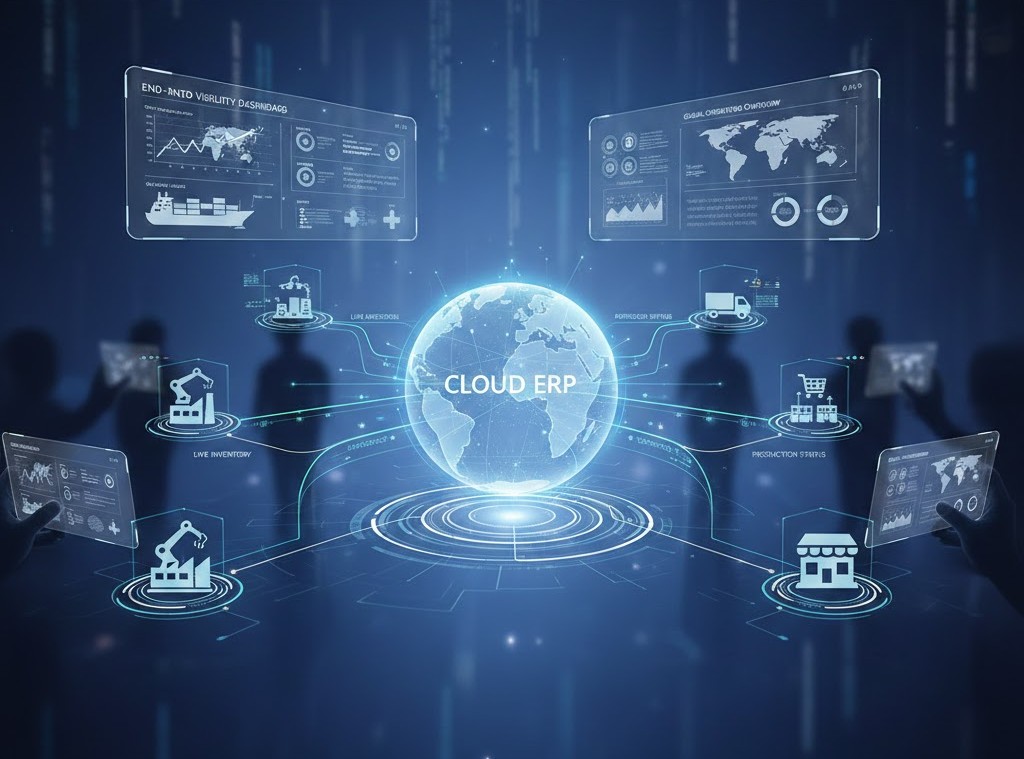
Supply chain visibility is the real-time ability to see and trust the flow of materials, orders, inventory, and financial impact. In manufacturing, that means knowing what’s where, what it costs, and what’s next. Cloud ERP integrates internal data from across the organization and eliminates data silos, providing a unified view that enhances transparency and collaboration.
Cloud ERP centralizes data, standardizes processes, and connects stakeholders (internal teams and external partners) to ensure decisions are based on current, complete information rather than spreadsheets or lagging reports. ERP and supply chain management are closely linked, with ERP in supply chain improving visibility and coordination across procurement, warehousing, logistics, and demand forecasting. This integration improves operational efficiency and enhances supply chain management capabilities, enabling organizations to respond proactively to disruptions.
Integrating ERP with supply chain management enhances data visibility, improves decision-making, and streamlines operations across the entire supply chain.

Why Visibility Is Critical for Modern Manufacturers
- Risk & Resilience: Spot shortages, delays, and quality issues early; re-plan quickly to address supply chain issues and improve overall supply chain performance.
- Working Capital: Optimize stock levels and reduce carrying costs by leveraging better demand and supply signals, enabling more effective supply chain planning.
- Customer Service: Promise realistic delivery dates, improve OTIF, and reduce expedites.
- Profitability: Tie operational decisions to financial impact (margin, variance, landed cost) in real time.
Supply chain planning is critical for anticipating demand and optimizing resources, and ERP systems provide the predictive analytics and scenario modeling needed to support proactive decision-making.
ERP systems help businesses anticipate and mitigate supply chain risks by improving demand forecasting and planning. Advanced analytics within ERP systems enable companies to identify potential bottlenecks and proactively address them, improving supply chain efficiency.
Problem → Consequence → Outcome: Siloed data causes poor forecasts → stockouts/overproduction → higher costs and missed SLAs. Cloud ERP breaks the cycle.
How Cloud ERP Improves Supply Chain Visibility
Cloud ERP enables visibility through integrated, real-time workflows:
- Supply chain management plays a crucial role in allowing integrated, real-time workflows through cloud-native technologies, dashboards, analytics, and IoT, enhancing supply chain and operational agility.
- Cloud-based ERP solutions provide scalability and real-time data access, allowing businesses to adapt quickly and improve collaboration with supply chain partners.
- Cloud-native platforms and IoT devices are increasingly integrated into ERP systems to capture real-time data on logistics and equipment health, further enhancing supply chain visibility.
Centralized, Real-Time Data Across the Supply Chain
Cloud ERP systems help organizations maintain optimal inventory levels, avoiding stockouts and excess inventory:
- Unified view of inventory, WIP, purchase orders, sales orders, and shipments, allowing managers to monitor inventory levels in real time and track stock, shipments, and supplier performance
- Lot/serial tracking for traceability and compliance
- Enhanced stock management through centralized data, improving inventory control, reducing costs, and increasing transparency across the supply chain
- Role-based dashboards for Finance, Operations, and Supply Chain Management
Integrated Planning, Execution, and Reporting
Cloud ERP solutions facilitate automated demand forecasting and replenishment planning to optimize inventory management. An ERP system with supply chain planning capabilities creates automatic supply and demand forecasts using historical and real-time data:
- MRP/APS aligned to real-time demand and capacity
- Embedded analytics (cost to serve, margin by product/customer, improving demand forecasting with integrated analytics)
- Automated alerts on lead times, variances, and exceptions
End-to-End Supply Chain Visibility: What Data Does Cloud ERP Provide?
True end-to-end visibility spans:
- Demand Planning & Forecasting
- Historical sales, seasonality, customer commitments, and forecast accuracy
- Scenario planning (e.g., demand spikes, line downtime)
- Procurement & Suppliers:
- Lead times
- Confirmations
- ASN tracking
- Quality performance
- Detailed tracking of raw materials sourcing and movement
- Inventory & Warehousing:
- On-hand
- In-transit
- Safety stock
- Cycle counts
- Slotting
- Manufacturing & Production:
- BOM/route fidelity
- Labor/machine utilization
- Scrap
- Variances
- Transportation & Fulfillment:
- Carrier status
- Freight cost
- Delivery proof
- Returns
- Integration with logistics providers
- Real-time monitoring of delivery delays
- Supplier, Logistics, and Lead-Time Data
- Confirmed vs. actual lead times, OTIF, quality metrics
- Shipment tracking, carrier SLAs, landed cost breakdowns
Cloud ERP systems provide granular visibility from raw material sourcing to final delivery, including sustainability tracking. Each stage feeds the next, with finance seeing the cost impact as it happens.
Key Benefits of Cloud ERP: Supply Chain Visibility
- Faster Decisions: Real-time signals reduce reaction time from days to minutes
- Lower Inventory Costs: Align stock with actual demand; avoid expediting and excess inventory
- Agility: Re-plan quickly when materials or capacity change
- Collaboration: Finance, Operations, Sales, and Suppliers operate from a shared truth
- Financial Control: Tie every operational move to cost and margin implications
- Enhance Operational Efficiency: Acumatica ERP, for example, can optimize supply chain management by automating processes, integrating departments, and leveraging AI to streamline operations and improve coordination.
Cloud ERP also automates tasks like purchase order creation and inventory replenishment, reducing manual errors.
Cloud ERP vs On-Prem ERP for Visibility
- Speed: Cloud delivers updates and integrations faster; on-prem lags with batch processes
- Scalability: Elastic capacity for analytics and data-intensive workflows
- Accessibility: Anywhere, role-based access for internal teams and partners
- Total Cost: Lower overhead (infrastructure/maintenance) and faster time to value
Common Challenges to Achieving Visibility
- Siloed Systems & Data Silos: MRP, MES, WMS, and finance are disconnected, leading to data silos that hinder data accessibility, transparency, and collaboration across functions and partners
- Data Quality: Inconsistent masters, inaccurate transactions, poor governance
- Supplier Integration: Manual updates and limited EDI/API connectivity
- Change Management: New processes require training, KPIs, and accountability
Cloud ERP also facilitates digital twin technology to simulate supply chain scenarios for proactive management.
How Cloud ERP Supports Supply Chain Resilience
- Scenario Planning: Model supplier outages, demand spikes, and capacity changes
- Early Warning: Exception alerts for delays, shortages, and cost variances, with artificial intelligence enabling predictive disruption management by analyzing external signals to forecast delays or bottlenecks
- Proactive Response: Re-allocate inventory, re-route shipments, and re-sequence production with financial visibility built in
Industries That Benefit Most
Cloud ERP streamlines operations across industries, helping business leaders improve efficiency and productivity.
- Discrete Manufacturing: Complex BOMs, engineer-to-order, traceability
- Distribution & Wholesale: Multi-location inventory, cross-docking, kitting
- Retail & eCommerce: Demand volatility, fulfillment speed, returns management
- Food & Beverage: Lot/expiry control, compliance, recall readiness
- Healthcare & Life Sciences: Serialization, quality, regulatory requirements
Getting Started: A Practical Path to Visibility
- Assess Gaps: Map current data flows and identify blind spots (e.g., supplier confirmations, WIP accuracy).
- Define KPIs: Forecast accuracy, OTIF, inventory turns, plan adherence, cost to serve.
- Choose the Right Cloud ERP: Align with manufacturing complexity, integration needs, and reporting depth.
- Phase the Rollout: Start with inventory accuracy + supplier lead times, then expand to planning and analytics.
- Governance & Training: Establish data ownership, master data standards, and role-based dashboards.
- Connect with Atlantic: Get expert implementation, guidance, and support to integrate suppliers, production, inventory, and finance; deliver real-time dashboards; automate alerts; and leverage scalable analytics to enhance your supply chain visibility and operational efficiency.
Frequently Asked Questions (FAQ)
What is supply chain visibility in cloud ERP?
It’s when finance sees the cost impact as operations happen. It’s real-time, end-to-end insight across procurement, production, inventory, and fulfillment in one integrated system. Cloud ERP provides enhanced visibility by integrating critical data across every stage of the supply chain, enabling organizations to make informed, quick, and efficient decisions.
How does cloud ERP improve supply chain visibility?
By centralizing data, integrating planning/execution, and delivering role-based analytics and alerts so teams act on current, complete information, cloud ERP platforms also leverage advanced supply chain management capabilities and integrations to improve visibility, agility, and risk mitigation. Additionally, cloud ERP enhances collaboration between internal teams and external partners through self-service portals and automated communication.
What data does cloud ERP provide for visibility?
Inventory balances and movements, WIP and production status, supplier confirmations and lead times, shipment tracking, and embedded financial metrics (cost, margin, variance) are all examples of critical data that cloud ERP systems provide for supply chain visibility. Access to this vital data, along with real-time internal data from across the organization, enables companies to improve demand planning, identify operational inefficiencies, and make better decisions. Additionally, cloud ERP systems help organizations maintain optimal inventory levels, avoiding stockouts and excess.
How does real-time data improve decision-making?
It shortens reaction times, prevents stockouts/expedites, aligns production with demand, and clarifies the financial impact of operational choices.
What are the biggest challenges?
Disconnected systems, data silos, inconsistent data, limited supplier integration, and change management are common challenges. Data silos hinder transparency and collaboration across different functions and partners. A phased implementation with strong governance resolves these. Additionally, cloud-native platforms can improve supplier performance ratings by up to 25% through real-time data sharing.
Why Atlantic, and Why Now?
Atlantic specializes in manufacturing ERP implementations that unlock end-to-end visibility, financial control, and resilience. We tailor processes, data governance, and integrations to your operation. We also deploy cloud solutions like Acumatica to optimize supply chain processes using ERP software for improved asset tracking, reduced downtime, and greater operational efficiency:
- Integrate suppliers, production, inventory, and finance in one platform
- Deliver real-time dashboards for F&O leaders
- Automate alerts and exceptions to protect service levels and margins
- Provide scalable analytics for continuous improvement
Ready to see what real visibility looks like? Let’s map your current state, quantify the ROI, and design a phased rollout that delivers results in weeks rather than years.
Contact Atlantic to start your visibility assessment.